
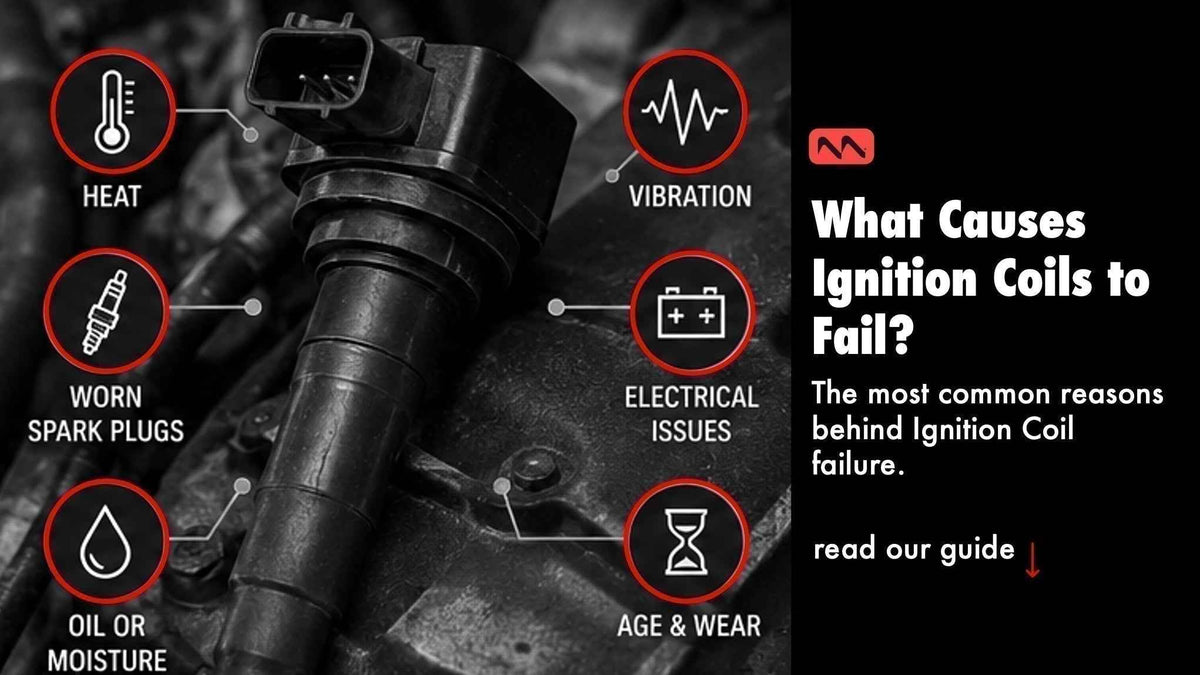
Ignition coils operate in one of the most demanding environments found anywhere on a modern car. But for such a critical component, they rarely get much attention! So what causes ignition coils to fail?
What Causes Ignition Coils to Fail? They are exposed to heat, vibration and repeated electrical loading, often while mounted directly onto the engine. Every time a spark plug fires, the ignition coil must convert the car’s low battery voltage into the much higher voltage needed to create a spark inside the combustion chamber.
Over time, this repeated stress will inevitably cause the coil’s internal insulation, windings, electrical connections or outer casing to deteriorate.
However, ignition coils do not always fail simply because they are old. A worn spark plug, oil-filled plug well or electrical fault can place additional strain on a coil and shorten its life considerably.
Understanding why a coil has failed is important. Replacing the component without correcting the underlying cause may result in the new coil developing the same problem.

1. Heat and repeated heat cycling
Heat is one of the main enemies of any electrical component.
Ignition coils are commonly positioned on or close to the cylinder head, where they are exposed to high temperatures - every single time the engine runs.
As the engine warms up and cools down, the coil repeatedly expands and contracts. Over thousands of heat cycles, this can affect:
- Internal insulation
- Soldered electrical connections
- Plastic housings
- Rubber seals and coil boots
- Potting compounds used to protect internal parts
Eventually, small cracks or weaknesses can form. These may allow the high voltage to escape internally or track along the outside of the coil instead of reaching the spark plug correctly.
Heat-related faults are often intermittent. A coil may operate normally when the engine is cold but begin to misfire once under-bonnet temperatures rise.
2. Worn spark plugs
Ignition coils and spark plugs work as a system.
As a spark plug wears, its electrodes gradually erode and the gap between them may increase. A larger gap generally requires more voltage to create a spark.
This forces the ignition coil to work harder every single time the cylinder fires.
If the spark plugs are left in service beyond their recommended replacement interval, the increased voltage demand can place unnecessary stress on the coils. Eventually, insulation may break down or the coil may become unable to supply the required output consistently.
Using the wrong spark-plug specification can create similar problems. The plug’s heat range, construction and electrode gap should all be suitable for the engine and its level of tune.
For this reason, replacing ignition coils without checking the spark plugs isn't good practice.
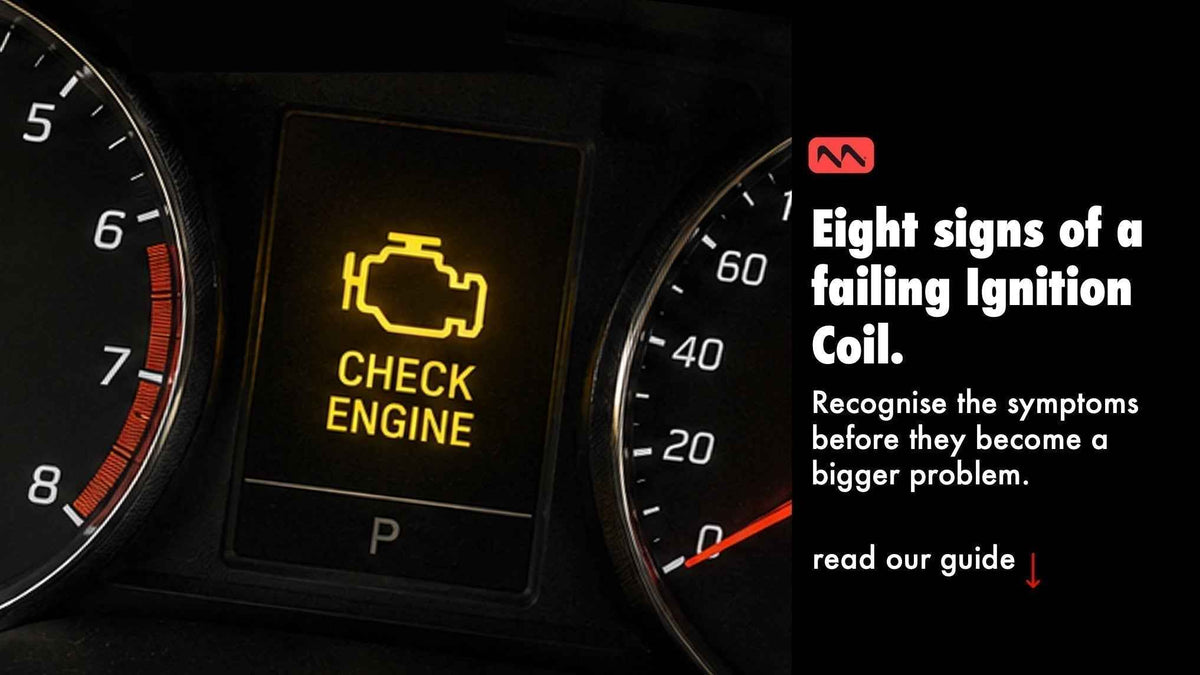
Read more : 8 signs of a failing ignition coil
3. Incorrect spark-plug gap
The spark-plug gap is the distance the spark must cross between the centre and ground electrodes.
If the gap is too wide, the ignition system may require more voltage than the coil can reliably provide under certain operating conditions. This is especially likely when cylinder pressure is high.
A gap that is too narrow may reduce the immediate voltage demand, but it can also affect the development of the spark and flame kernel.
Modified and high-boost engines sometimes require a different plug specification or gap from a standard engine. However, adjusting the gap should be part of a properly considered ignition strategy - not a quick attempt to hide a weak coil or unresolved misfire.
4. Oil inside the spark-plug wells
Many coil-on-plug ignition coils sit inside deep spark-plug wells in the cylinder head or cam cover.
If a cam-cover gasket or spark-plug-tube seal begins to leak, engine oil can collect around the ignition coil and spark plug.
Oil contamination can:
- Damage the rubber coil boot
- Affect the insulation between the coil and spark plug
- Soften seals and plastics
- Encourage voltage tracking
- Contaminate the electrical connector
- Make the coil difficult to remove
Installing a new coil into an oil-filled plug well without repairing the leak is likely to expose the replacement to the same damaging conditions.
The well should be cleaned carefully and the source of the oil leak repaired before new ignition components are installed.
5. Water and moisture ingress
Moisture can also interfere with the high-voltage path between the coil and spark plug.
Water may enter the spark-plug well because of:
- Damaged engine-cover seals
- Poorly fitted coil boots
- Blocked drainage channels
- Careless pressure washing
- Heavy rain entering through poorly sealed bodywork
- Coolant or washer-fluid leaks nearby
Moisture can lead to corrosion, electrical leakage and visible tracking marks along the coil boot or spark-plug insulator.
So if your car begins to misfire immediately after engine-bay cleaning, check it for water around the ignition coils before any parts are replaced.
6. Engine vibration
An ignition coil may look like a tough, solid, simple component from the outside, but inside it contains fine windings and internal electrical connections.
Constant engine vibration can fatigue these internal parts over time. Excessive vibration caused by worn engine mounts, rough running or incorrect installation can increase the stress further.
A coil that is not properly secured may also move within the spark-plug well, damaging the boot, connector or internal components.
Correct installation and the use of the proper fixings are therefore important for long-term reliability.
7. Age and insulation breakdown
Ignition coils do not necessarily have a universal replacement interval, but they do deteriorate with age and use.
It does depend on many factors, but we always recommend changing coils after an absolute maximum of 60,000 miles / 100,000 kms.
The high voltage generated inside the coil places considerable stress on its insulation. Over time, microscopic cracks and weak points may develop.
When the insulation begins to break down, the voltage can follow an unintended path. This may happen internally or along the outside of the coil body.
Take a closer look at yours. Visible evidence can include:
- Fine cracks in the housing
- White or grey tracking marks
- Burn marks
- Carbon deposits
- Damage to the rubber boot
- Corrosion around the terminals
Not all internal failures will be visible, so a coil that looks perfect from the outside may still be unable to perform correctly under load.
8. Damaged connectors or wiring
Ignition coils rely on a stable electrical supply and an accurate control signal from the engine-management system.
Problems can arise from:
- Loose electrical connectors
- Corroded terminals
- Broken locking tabs
- Damaged wiring
- Poor earth connections
- Excessive resistance in the circuit
- Previous repairs or modifications
A wiring fault may affect one coil, several coils or the entire ignition system.
So, simply replacing a coil without checking its power supply and control circuit may therefore fail to solve the problem.
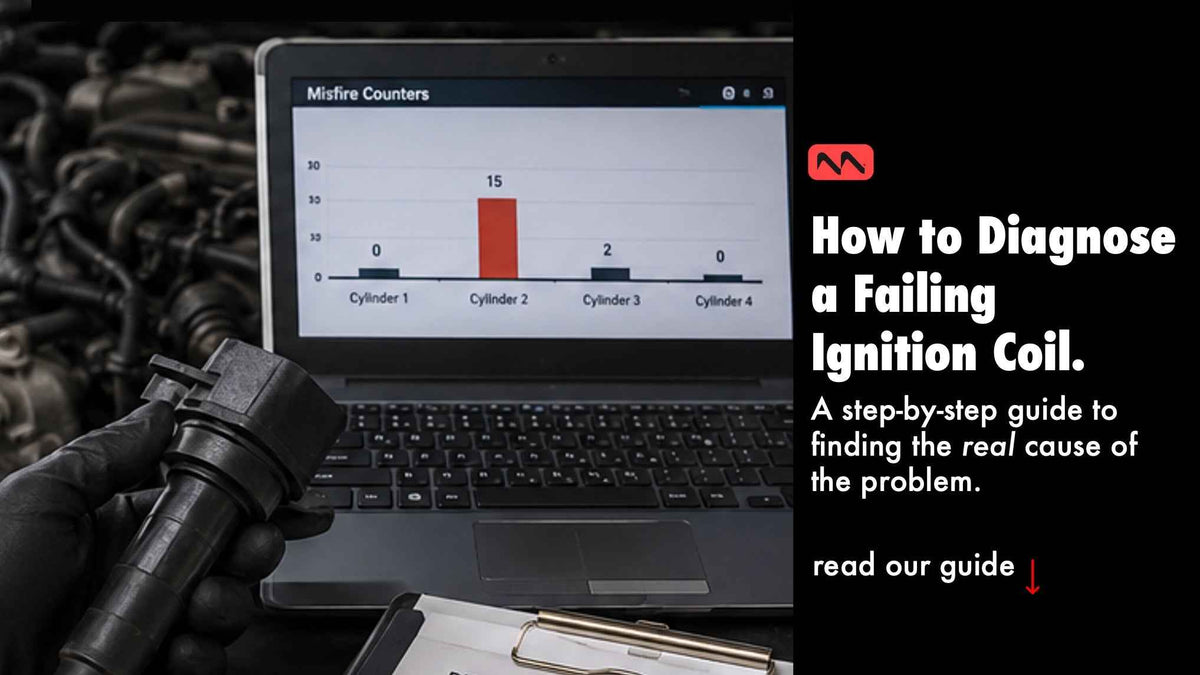
Read more : 10 steps to diagnose a failing ignition coil
9. Battery and charging-system problems
Ignition coils are designed to operate within the electrical conditions specified by the vehicle manufacturer.
A weak battery, poor charging voltage or unstable electrical supply can affect how the ignition and engine-management systems operate.
Low voltage during cranking may contribute to difficult starting, while an overcharging alternator can expose electrical components to excessive voltage.
Battery and charging faults may also create symptoms that resemble ignition-coil failure. The vehicle’s supply voltage should therefore be checked where several coils appear to be affected at once.
10. Increased demands from a tuned engine
Engine modifications can increase the demand placed on the ignition system.
Higher boost pressure, greater cylinder filling and increased torque all make the air-fuel mixture more difficult to ignite reliably. Higher engine speeds also reduce the time available between ignition events.
A healthy original-equipment coil may have sufficient reserve for a standard engine but begin to operate closer to its limits after significant tuning.
This certainly does not mean that tuning automatically damages ignition coils. However, ageing coils, worn spark plugs and marginal ignition components are more likely to reveal themselves once cylinder pressure and engine load increase.
For modified vehicles, the condition and specification of the complete ignition system should be considered as part of the tuning package.
11. Poor-quality replacement coils
This is a surprisingly common problem. The market is flooded with low-cost replacement coils, many of which use inferior insulation materials, windings, electronics, seals or mouldings. A coil may fit physically and look identical to the original, it may well still provide an inconsistent output or inadequate durability.
As the Mantis team have learned all too well from testing other OE and aftermarket-brand coil packs, not all ignition coils are manufactured to the same standard.
Possible warning signs include:
- Poor connector fit
- Loose or uneven mouldings
- Weak sealing around the boot
- Inconsistent performance between cylinders
- Early failure under heat or load
- Unexplained misfires shortly after installation
A replacement coil should match the electrical and physical requirements of the engine, rather than simply resembling the original component on the outside.
Why identifying the cause matters
When an ignition coil fails, it is tempting to replace it and consider the problem solved.
That may well be sufficient where the failure is simply the result of age. However, if the coil has been damaged by a worn spark plug, oil leak, water ingress or wiring fault, fitting a new one without addressing the cause may only provide a temporary repair.
So before installing a replacement coil, check:
- The spark-plug condition and specification
- The electrode gap
- The condition of the plug well
- The coil connector and wiring
- Any visible oil or moisture
- The battery and charging voltage where relevant
- Whether other coils of the same age are showing similar symptoms
Should ignition coils be replaced as a complete set?
It is not always necessary to replace every ignition coil when one fails.
Replacing a single coil may be reasonable when the remaining coils are relatively new and the failure has a clear isolated cause.
But a full set may make more sense when:
- All coils are the same age and mileage
- More than one cylinder is showing intermittent faults
- The engine has experienced repeated coil failures
- Access requires significant labour
- The vehicle is tuned or used under sustained high load
- Consistent performance across every cylinder is a priority
The decision should be based on the vehicle’s age, condition, use and service history.
Read more : What causes ignition coils to fail?
Preventing repeat ignition-coil problems
Ignition-coil life can often be improved by maintaining the wider ignition system properly.
Use correctly specified spark plugs, replace them at appropriate intervals and investigate any oil or moisture found around the coils. Electrical connectors should be handled carefully, and any misfire should be diagnosed before prolonged driving causes additional problems.
At Mantis, we specialise exclusively in ignition coils. Nothing else.
Our High Performance coils are engineered as direct replacements for the original components, with a focus on strong, consistent ignition performance and dependable operation under demanding conditions.
Read more : the tech inside Mantis High Performance ignition coils

Leave a comment
All comments are moderated before being published.
This site is protected by hCaptcha and the hCaptcha Privacy Policy and Terms of Service apply.