
Ignition coils are among the hardest-working components in a modern petrol engine. So why is it that they're so often overlooked?
Every time the engine fires, each coil converts the car’s relatively low battery voltage into the much higher voltage needed to create a spark across the spark-plug gap. This process happens thousands of times every minute, often in an environment filled with heat, vibration and electrical stress.
An ignition coil can fail completely, but deterioration is often more gradual. A weakening coil may work perfectly well during gentle driving but struggle when the engine is hot, accelerating hard or operating under increased load.
And it's this slow, gradual deterioration over time that can make it so hard to notice any drop in performance.
Did the car used to have that flat spot when it was newer? Did it used to pull harder? Is it rougher at idle than before? It's all to easy for your mind to play tricks on you when it's a gradual loss of spark-energy.
So, that can make ignition-coil problems difficult to identify. The first sign may be an occasional hesitation, a rough idle or an engine warning light that appears without an obvious change in the way the car drives.
So from all of our experience in engineering our Mantis high-output coils, here are eight of the most common signs that one or more ignition coils may be failing, or just deteriorating. It's a long read, but worth it for anyone who cares about understanding the health of their car and engine:
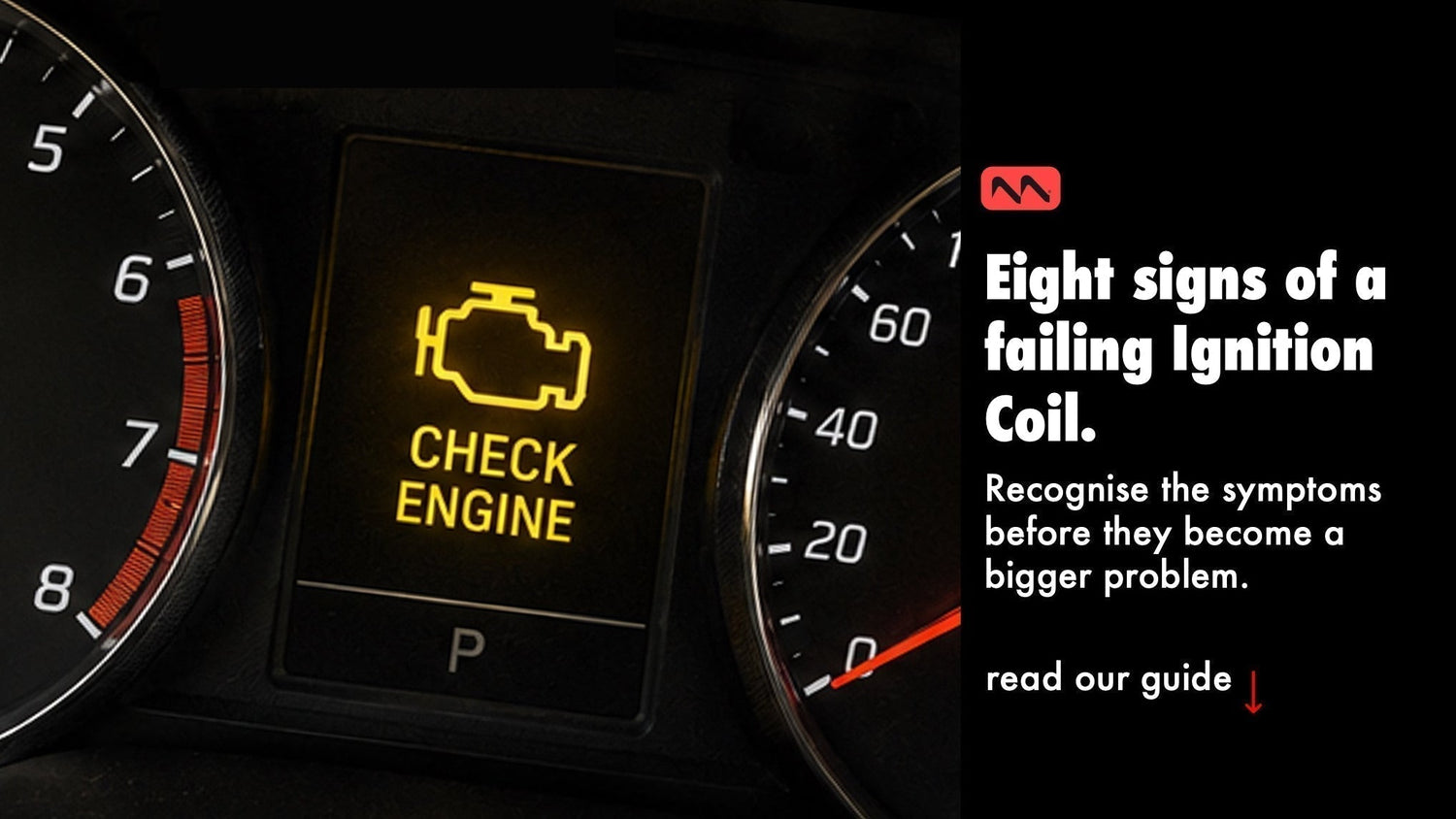
1. The engine warning light comes on
Generally, this is the easiest diagnosis to spot. A failing ignition coil can cause the engine control unit to detect irregular combustion or a misfire in one or more cylinders.
This will often illuminate the engine warning light and store a diagnostic fault code. Codes beginning with P0300 are commonly associated with misfires:
- P0300: Random or multiple-cylinder misfire detected
- P0301: Misfire detected on cylinder one
- P0302: Misfire detected on cylinder two
- P0303: Misfire detected on cylinder three
- P0304: Misfire detected on cylinder four
- And of course, this sequence continues on engines with more cylinders.
A cylinder-specific fault code can help narrow down the problem, but it does not prove that the ignition coil is responsible. Worn spark plugs, faulty injectors, wiring problems and mechanical issues can produce similar codes.
A flashing engine warning light should be taken particularly seriously. It normally indicates that the engine is actively misfiring, rather than simply storing a historic or intermittent fault.
Read more : How to diagnose a suspected ignition-coil fault
2. A rough or uneven idle
A healthy petrol engine should generally maintain a stable idle and feel smooth at all rpms.
But when an ignition coil becomes weak or fires intermittently, the affected cylinder may not combust consistently. This can make the engine feel lumpy, uneven or unusually harsh when stationary.
You may notice:
- Vibration or a tremor through the steering wheel, seat or bodywork
- Engine speed fluctuating at idle
- An uneven exhaust note
- Increased vibration when stationary
- Rough running immediately after a cold start
We often find that an ignition problem may be particularly noticeable at idle because there is lower engine speed and momentum to disguise the contribution of an inconsistently firing cylinder.
Don't rush to assume that it must be a failed coil!
Rough idling can have many causes, including air leaks, injector problems, carbon deposits and worn spark plugs. So it should be treated as a reason to investigate - and although a coil failure is a very likely explanation, it's not an automatic confirmation.
3. Hesitation or jerking during acceleration
A weakening ignition coil may appear to operate normally while the engine is under light load.
The problem often becomes more noticeable when you press the accelerator and ask the engine to produce more torque. As cylinder pressure rises, the ignition system has to work harder to fire the air-fuel mixture reliably.
Instead of accelerating cleanly, the car may:
- Hesitate momentarily
- Stumble as the throttle is opened
- Jerk or surge
- Feel flat through part of the rev range
- Respond inconsistently to the accelerator
The symptom may initially appear only under a particular combination of engine speed, throttle opening and temperature.
Because the fault can disappear when the throttle is reduced, an intermittent ignition problem may not be obvious during gentle driving or a basic workshop inspection.
4. Misfires under boost or high engine load
Misfires during hard acceleration are especially common where an ignition system is becoming marginal.
This is particularly relevant to turbocharged, supercharged and tuned engines. Higher cylinder pressure makes it more difficult for the spark to bridge the gap between the spark-plug electrodes.
An ageing or weakened coil may continue to fire the mixture during ordinary driving but begin to struggle when the engine is:
- Producing high boost pressure
- Accelerating at full throttle
- Pulling from low engine speed in a high gear
- Climbing a steep gradient
- Operating at high RPM
- Experiencing high under-bonnet temperatures
The result may be a sharp hesitation, repeated stuttering or a sudden interruption in power.
On a modified vehicle, a misfire under load does not necessarily mean the ignition coils are faulty. Spark-plug condition, plug specification, electrode gap, fuelling and engine calibration must also be considered.
5. Reduced engine power
When a cylinder fails to combust correctly, it contributes less torque to the engine’s total output.
A weak ignition coil can therefore make the car feel slower, less responsive or reluctant to rev cleanly.
The loss of performance may be dramatic if a coil fails completely, but gradual deterioration can be harder to recognise.
Possible symptoms include:
- Weaker acceleration
- Slower throttle response
- Difficulty reaching higher engine speeds
- Inconsistent power delivery
- The vehicle entering a reduced-power mode
Modern engine-management systems may deliberately limit boost, throttle opening or engine speed when repeated misfires are detected. This helps protect the engine and emissions-control system, but it can make the car feel as though it has suddenly lost a significant amount of power.
6. Difficult starting
An engine needs a strong and accurately timed spark during starting, particularly when cold.
A deteriorating ignition coil may cause the engine to take longer to fire, require several attempts or run unevenly for the first few seconds after starting.
You may experience:
- Longer cranking before the engine starts
- Difficult cold starts
- The engine starting and immediately cutting out
- Rough running immediately after starting
- An intermittent failure to start
A single failed coil will not always prevent a multi-cylinder engine from starting, because the remaining cylinders may still fire. However, several weak coils or a fault affecting their shared electrical supply can make starting considerably more difficult.
Battery condition, fuel pressure and engine sensors can also cause similar symptoms, so proper diagnosis remains important.
7. Stalling or cutting out
When a coil failure gets worse, an intermittent ignition fault can cause the engine to stall, particularly when returning to idle or operating at low speed.
The car may restart immediately, making the fault difficult to trace. But in other cases, it may need to cool down before starting normally again.
Heat-related coil problems can be especially deceptive and hard to trace.
A coil may work correctly when cold but begin to fail once the engine bay reaches operating temperature.
This sort of stalling can also be caused by fuel-pressure problems, crankshaft sensors, camshaft sensors, charging faults and several other issues. Because an unexpected stall can create a safety risk, the vehicle should be inspected promptly.
8. Worsening fuel economy
A gradual reduction in fuel economy can sometimes indicate inconsistent combustion.
If the air-fuel mixture is not being ignited properly, the engine may use more fuel to produce the requested performance. The driver may also compensate without realising they're doing so by pressing the accelerator further, and for longer.
You may notice:
- Reduced range from a tank of fuel
- Higher displayed average fuel consumption
- Rough running or hesitation
- Increased exhaust emissions
- A noticeable fuel smell from the exhaust
Of course, fuel economy is affected by driving style, journey length, weather, traffic and tyre pressures, as well as the mechanical condition of the car. A small change in consumption alone is not strong evidence of a failing ignition coil.
However, declining fuel economy accompanied by misfires, rough idling or cylinder-specific fault codes certainly deserves further investigation.
Can you continue driving with a failing ignition coil?
A car may continue to run with a minor or intermittent coil fault for a long time, but prolonged driving with an active misfire is certainly not recommended.
A misfiring engine may lose power unexpectedly, run roughly and send unburnt fuel into the exhaust system. Continuing to drive hard or demand high boost can worsen the problem and place unnecessary stress on other components.
So don't ignore the symptoms!
Try to reduce engine load wherever possible and arrange a diagnosis as soon as possible.
However, stop driving and seek assistance if:
- The engine warning light is flashing
- The engine is shaking or vibrating heavily
- Power has reduced dramatically
- The car is repeatedly stalling
- The vehicle no longer feels safe to drive
What should you do next?
Any of the eight symptoms above can indicate a weak or failing ignition coil, but several other faults can produce similar behaviour.
The next step is to examine the wider ignition system, including the spark plugs, coil connectors, wiring and spark-plug wells. Stored fault codes and live misfire data can also help identify which cylinder is affected. We've got other articles to take you through the next stages of diagnosis and understanding of the situation:
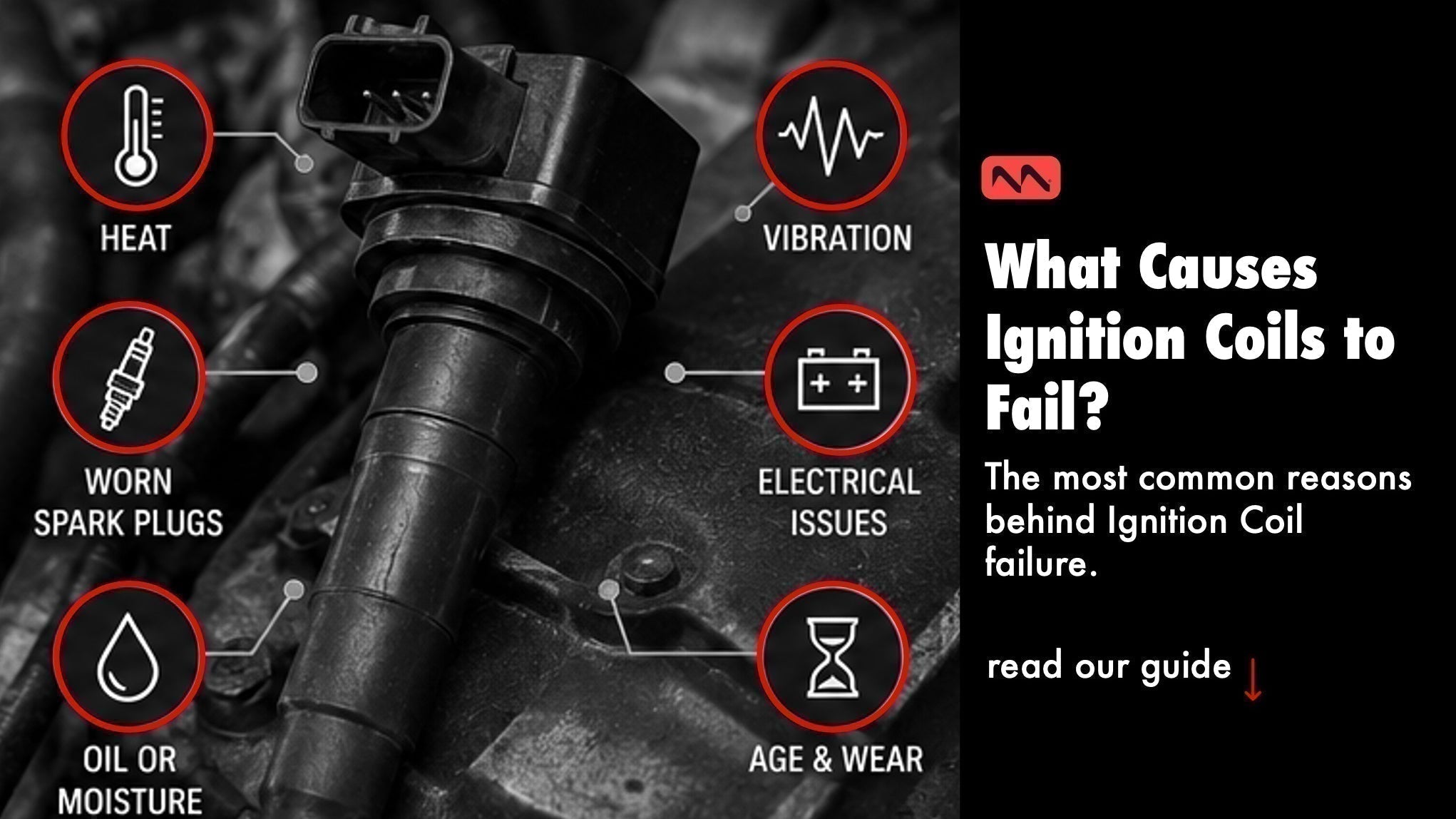
Read more : What causes ignition coils to fail?
Read more : How to diagnose a failing ignition coil.
At Mantis, ignition coils are not one component among thousands. They are our entire focus.
Mantis high-output ignition coils are engineered as direct replacements for the original components, providing strong and consistent ignition performance for standard, tuned and high-performance applications.
So when the time comes to replace, choose the best!

Leave a comment
All comments are moderated before being published.
This site is protected by hCaptcha and the hCaptcha Privacy Policy and Terms of Service apply.